15 Powerful Reactive Dog Training Tips That Actually Get Results

A reactive dog — one that barks, lunges, and loses its mind at triggers like other dogs, strangers, or traffic — is one of the most challenging behavior issues for owners to deal with, because it happens fast, in public, and is immediately embarrassing. I’ve been there. My second dog, a rescue Border Collie mix, would turn into a different animal the moment he spotted another dog across the street.
What I learned: reactive dog training is not about suppressing the reaction. It’s about changing what the trigger means to the dog. Every effective method comes back to that principle.
Reactivity that involves biting humans or other animals, or that is accompanied by stiff body posture and hard staring, may have an aggression component beyond typical reactivity. Consult a certified professional dog trainer or veterinary behaviorist for these cases before attempting self-directed modification.
What reactive dog training is actually trying to do
Before the tips, the framework. Reactive dogs have formed a negative emotional association with specific triggers — other dogs, strangers, bikes, whatever activates them. The reaction (barking, lunging) is the behavioral expression of that negative emotion. Most reactive dog training approaches that fail try to suppress the behavior. Approaches that work try to change the underlying emotion.
Counter-conditioning is the core mechanism: pairing the trigger with something the dog loves (high-value food) at an intensity where the dog notices the trigger but doesn’t yet react. Over many repetitions, the trigger begins to predict good things rather than threatening things. The emotional response changes. The behavior follows.
15 powerful reactive dog training tips
1. Find your dog’s threshold — and stay under it
The threshold is the distance from a trigger at which the dog first notices it but hasn’t yet reacted. For some dogs this is 50 feet; for others, 200 feet. Your job during training is to stay under this threshold — working at distances where the dog can notice the trigger and then look back at you for a treat.
Above threshold (reactive, lunging, barking) = not learning. Under threshold = learning. Every training session should be at sub-threshold distances.
2. Use extraordinarily high-value treats
Standard kibble doesn’t compete with a charging emotional response. Use the dog’s absolute highest-value food: cooked chicken, hot dogs, cheese, freeze-dried liver. The treat needs to be valuable enough to interrupt the trigger association reliably.
Reserve these ultra-high-value treats exclusively for reactive dog training — keeping them special preserves their motivational power.
3. Practice “look at that” (LAT)
LAT is a foundational reactive dog training exercise developed by Leslie McDevitt in “Control Unleashed”:
- Set up at sub-threshold distance from a trigger
- The moment the dog looks at the trigger, say “yes” and deliver a treat
- The dog learns: trigger appears → look at it → look back at owner → treat
- Over many repetitions, the dog starts automatically looking at the trigger and then checking back with you
The dog is no longer fixated on the trigger — it’s become a cue to engage with the owner instead.
4. Master the emergency U-turn
When you’re caught above threshold — you’ve turned a corner and suddenly there’s a trigger at close range — you need an escape strategy. Train the U-turn in neutral environments first:
- Say a happy “let’s go!”
- Turn and move away quickly
- Reward the dog for following you
This becomes your exit strategy for situations you can’t manage at threshold distance.
5. Never punish the bark or lunge
Punishing the reactive behavior — leash corrections, spray bottles, shouting — suppresses the warning signal and adds aversive experience to an already stressed dog. It doesn’t change the emotional association. The dog that stops barking because it’s being punished is still a reactive dog — it’s now also a less predictable one because it no longer warns before snapping.
6. Make a “watch me” cue automatic
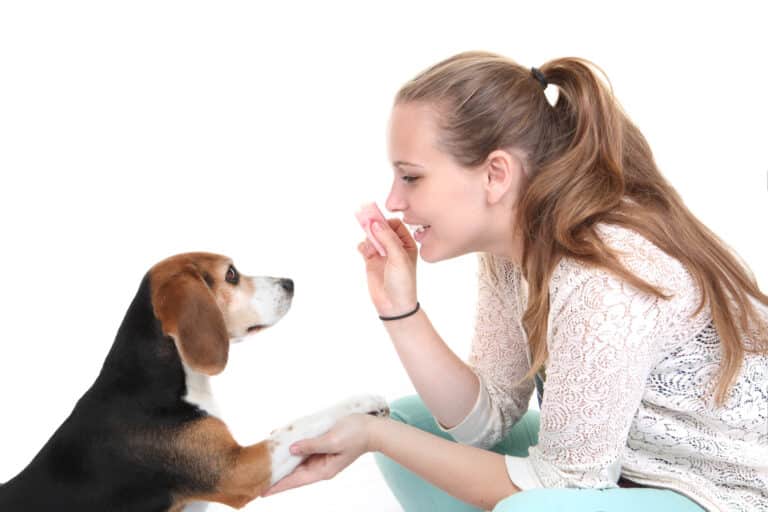
Train eye contact on cue: say “watch me” and reward the dog for looking at your face. Progress from easy environments to progressively more distracting ones. In reactive situations, a reliable “watch me” gives you a way to redirect the dog’s attention before it fixates on the trigger.
The key is practicing it in easy environments until it’s automatic before expecting it to work in difficult ones.
7. Manage your leash tension
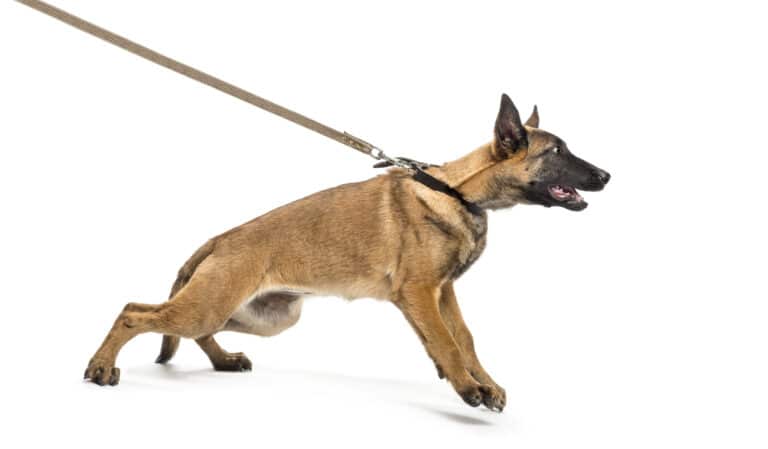
Leash tension telegraphs your anxiety to the dog and physically restricts their movement in a way that increases arousal and reactivity. When you see a trigger, consciously loosen the leash. Keep slack in it. Your body language communicates to the dog whether this situation is dangerous.
A tight leash + tense body = owner thinks this is a threat. A loose leash + calm body = owner isn’t worried.
8. Use a front-clip harness or head halter
Management tools don’t fix reactivity but they make it safer to manage during training. A front-clip harness turns the dog toward you when they pull rather than allowing forward momentum toward the trigger. A head halter (like a Gentle Leader) allows directional control of the head.
Neither of these is appropriate as the sole approach — they’re training tools, not solutions.
9. Practice “mat” or “place” training
Teaching a solid “go to mat” behavior gives you a management tool in situations where the dog needs to stay calm in the presence of triggers. A dog that has been rewarded hundreds of times for lying on a specific mat in increasingly challenging environments begins to self-regulate when placed there.
10. Increase physical and mental exercise
A well-exercised, mentally stimulated dog has lower baseline arousal — and lower baseline arousal means a higher threshold before the reactive response fires. Puzzle feeders, scent work, training sessions, and vigorous daily exercise all contribute to a calmer reactive dog, even before specific counter-conditioning work.
11. Identify and manage all triggers consistently
Reactive dogs often have multiple triggers — not just the primary one. An inconsistent trigger list means the dog is sometimes above threshold when you don’t expect it. Map all known triggers, rank them by difficulty, and apply threshold management to all of them.
12. Work with a trainer who understands reactivity
Reactive dog training done well is nuanced. A trainer who understands threshold theory, counter-conditioning mechanics, and the specific presentation of your dog’s reactivity produces results faster than self-directed work alone — particularly for moderate to severe cases.
Look for a Certified Professional Dog Trainer (CPDT-KA) or a trainer with specific experience in reactive dog rehabilitation.
13. Enroll in a reactive dog class
Reactive dog classes are specifically designed environments where owners work on reactivity in controlled proximity to other reactive dogs — all at sub-threshold distances, all managed carefully. The controlled exposure is more productive than trying to replicate the same learning in real-world unpredictability.
14. Track progress systematically
Reactivity progress is often gradual and easy to miss day-to-day. Track threshold distance over time: if the dog that couldn’t handle another dog at 100 feet can now work calmly at 50 feet, that’s significant progress even if the behavior still looks the same when triggered. Progress tracking maintains motivation.
15. Rule out pain and medical causes
Sudden increase in reactivity in a previously manageable dog, or reactivity that appeared in a dog that was previously sociable, sometimes has a medical component. Pain — dental, orthopedic, neurological — lowers the threshold for all stress responses. A vet check is appropriate before extensive behavior modification for sudden onset reactivity.
For more on managing dog behavior, see our guides on how to stop dog aggression, dog body language, and how to get your dog to stop barking at other dogs. The ASPCA’s guide on dog reactivity and Patricia McConnell’s work on reactive dogs are excellent further resources.
Michael Burrows has owned dogs for over 15 years and writes about dog training from personal experience and research. For severe reactivity, consult a professional.