How to Train a Kitten: 9 Simple Tips That Actually Work

Most people assume cats can’t be trained. I used to think the same thing, until I spent an afternoon watching a friend’s Bengal cat perform a sequence of behaviors on cue — sit, high five, spin, go to mat — with the focused attention of a well-trained dog. The difference wasn’t the cat. It was that my friend understood what cats are motivated by and worked with that, rather than against it.
How to train a kitten is genuinely achievable for any owner willing to understand two things: cats are not dogs, and feline motivation is primarily food and play, not social approval. Get those two things right and kittens are remarkably trainable.
Why training kittens is easier than training adult cats
How to train a kitten is easier than training an adult cat for the same reason puppy training is easier than adult dog training: the nervous system is still forming, habits haven’t been established, and the kitten is primed for learning new information. The window between 3 and 16 weeks is particularly valuable — this is when kittens are most open to accepting new experiences, people, handling, and environmental stimuli as normal.
This doesn’t mean adult cats can’t be trained. It means starting with kittens produces faster results with less effort.
How to train a kitten: 9 simple tips
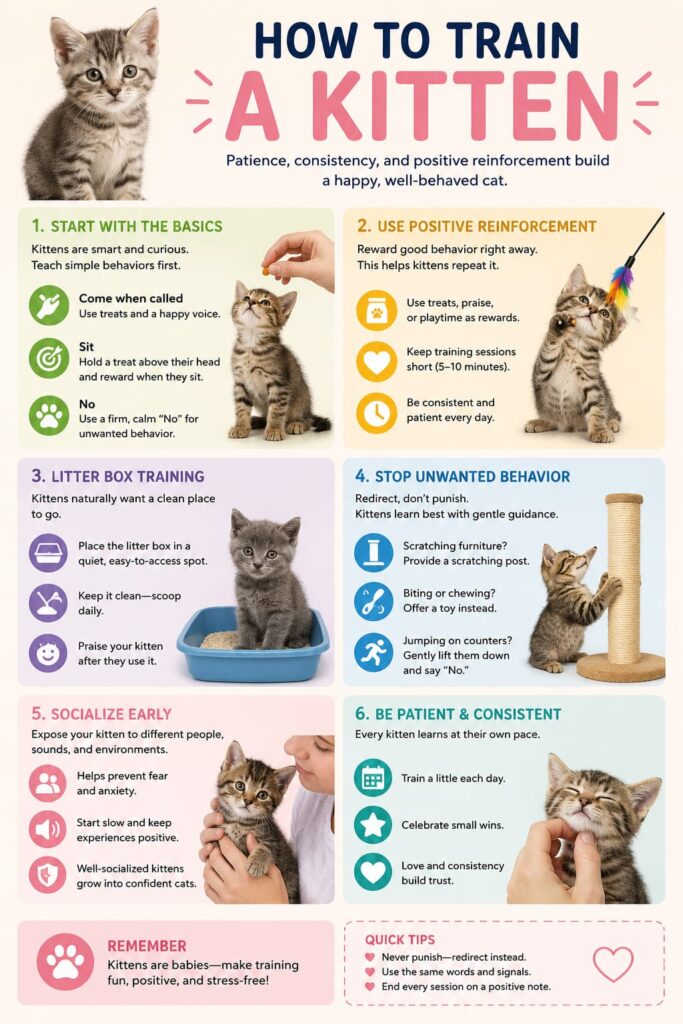
1. Use food as your primary training tool
Cats are not motivated by praise the way dogs are. They are motivated by food — specifically, high-value food they don’t get all the time. Small pieces of cooked chicken, tuna, commercial training treats, or even the kitten’s regular wet food served from a spoon work well.
Feed main meals from puzzle feeders or use them as training rewards. A kitten that isn’t hungry won’t work for food rewards. Train before meals, not after.
2. Keep sessions very short
Three to five minutes maximum per training session. Kittens have limited attention spans and will disengage when they’ve had enough — usually by walking away, grooming themselves, or looking at something else. These are not signs of failure. They’re cues to end the session.
Multiple short sessions throughout the day produce far better results than one long session. Five 3-minute sessions beats one 15-minute session significantly.
3. Use a clicker or consistent marker word
A clicker (or a consistent short word like “yes”) marks the exact moment the kitten does the right thing. This precision is important in cat training because the window between the behavior and the reward is very short — cats don’t stay focused long enough for delayed rewards to be meaningful.
Training sequence: kitten does the behavior → click or “yes” → treat within 2–3 seconds. The marker tells the kitten exactly what earned the reward.
4. Start with the simplest behaviors
Begin with behaviors that are natural and easy: sit, come when called, and targeting (touching your finger with their nose). These build the kitten’s understanding of the training process — that specific behaviors produce rewards — and establish communication before moving to more complex behaviors.
Sit: Hold a treat above the kitten’s head and slightly back — the natural head movement upward brings the bottom down. The moment the bottom touches the floor, click and treat.
Come: Say the kitten’s name followed by “come” while the kitten is nearby and already oriented toward you. Reward every time they close the distance. Never call the kitten to you for something unpleasant (medication, bath).
Targeting: Hold your finger out and wait for the kitten to sniff it. Click and treat. Gradually move the finger further so the kitten has to move to touch it.
5. Litter box training — the most important early lesson
Most kittens learn litter box use quickly, but the environment has to be right:
- One box per cat plus one extra — for a single kitten, two boxes in different locations
- Uncovered boxes initially — kittens often reject covered boxes
- Low-sided boxes accessible for small kittens — a cardboard box with one low side cut works perfectly
- Fine-grain unscented clumping litter — closest to natural substrate
- Clean daily
Place the kitten in the box after meals, after play, and after naps. Reward successful use with a small treat. If accidents happen elsewhere, clean with enzymatic cleaner and don’t punish.
6. Socialize during the critical window
The socialization window (3–16 weeks) is when exposure to people, handling, sounds, and environments has the most lasting positive impact. During this period:
- Handle the kitten daily — touching paws, ears, mouth, tail
- Expose to different people including children, if applicable
- Introduce to car travel, carrier use, and the vet environment positively
- Allow exploration of different surfaces, sounds, and environments
The cat that handles vet visits, handling, and novel situations well in adulthood is almost always a cat that was broadly socialized as a kitten.
7. Train “no” environments rather than punishing
Cats don’t respond well to punishment — it damages trust and doesn’t teach what to do instead. Rather than punishing counter-jumping, make the counter unpleasant (double-sided tape, aluminum foil) while making an alternative (a tall cat tree nearby) very attractive.
This “environmental management” approach produces better results and preserves the relationship between owner and cat.
8. Teach them to accept handling and grooming
Train the kitten to accept and ideally enjoy: having paws touched, nails trimmed, ears examined, teeth touched, and being placed in a carrier. Do this gradually with pairing (touch ear → treat, touch paw → treat) until the kitten is comfortable.
This investment in the first few months pays dividends for the rest of the cat’s life in reduced vet stress, easier grooming, and safer handling.
9. Be patient and consistent
Cats learn through repetition and positive association. Some behaviors take days; others take weeks. Consistency across sessions — same cue word, same reward timing, same marker — accelerates learning. Inconsistency slows it.
The relationship built through positive training sessions — a kitten that associates you with good things and interesting activities — is one of the foundations of a well-adjusted adult cat.
For more on kitten care and behavior, see our guides on why is my kitten so hyper, how to make a kitten like you, and complete cat behavior guide. The ASPCA guide to cat behavior and Cornell Feline Health Center are also excellent references.
Michael Burrows has owned cats his entire life and writes about feline behavior and training from personal experience and research. Educational content only.