How to Crate Train an Older Dog: The Complete Proven Adult Guide
Published May 2026 | 7 min read
Table of Contents
Learning how to crate train an older dog is completely achievable — despite the common myth that adult dogs cannot learn new habits. Whether you have a new rescue with no crate history, a dog that needs post-surgery rest, or an adult dog you want to prepare for travel, the same positive reinforcement principles apply.
According to Purina training experts, adult dogs can focus for longer periods than puppies, which actually makes them capable and often faster learners once they understand what is being asked. The process for how to crate train an older dog just needs to be slower, more patient, and more enrichment-focused than puppy crate training.
This guide walks you through every step — from choosing the right crate to building up to overnight crating — with specific guidance for rescue dogs and dogs with difficult histories.
📌 Internal link: How to teach a dog to lie down → https://staging.dogsandcatshq.com/how-to-teach-a-dog-to-lie-down-4588
📌 Internal link: How to teach a dog to come when called → https://staging.dogsandcatshq.com/how-to-teach-a-dog-to-come-when-called-4594
Why Crate Train an Adult Dog?
There are several legitimate reasons to learn how to crate train an older dog:
- Your dog is a rescue with no previous crate training
- Your dog is destructive when left alone and needs a safe contained space
- Your dog needs post-surgical rest and restricted movement
- You are preparing your dog for travel that requires a crate
- Your dog has separation anxiety and a properly introduced crate can provide security
- You are house training a dog that still has accidents
| ⚠️ Crates are not punishment Never put your dog in a crate as punishment for bad behaviour. This creates a negative association that makes how to crate train an older dog much harder. The crate must always be associated with good things — treats, meals, toys, and rest. |
Step 1 — Choose the Right Crate
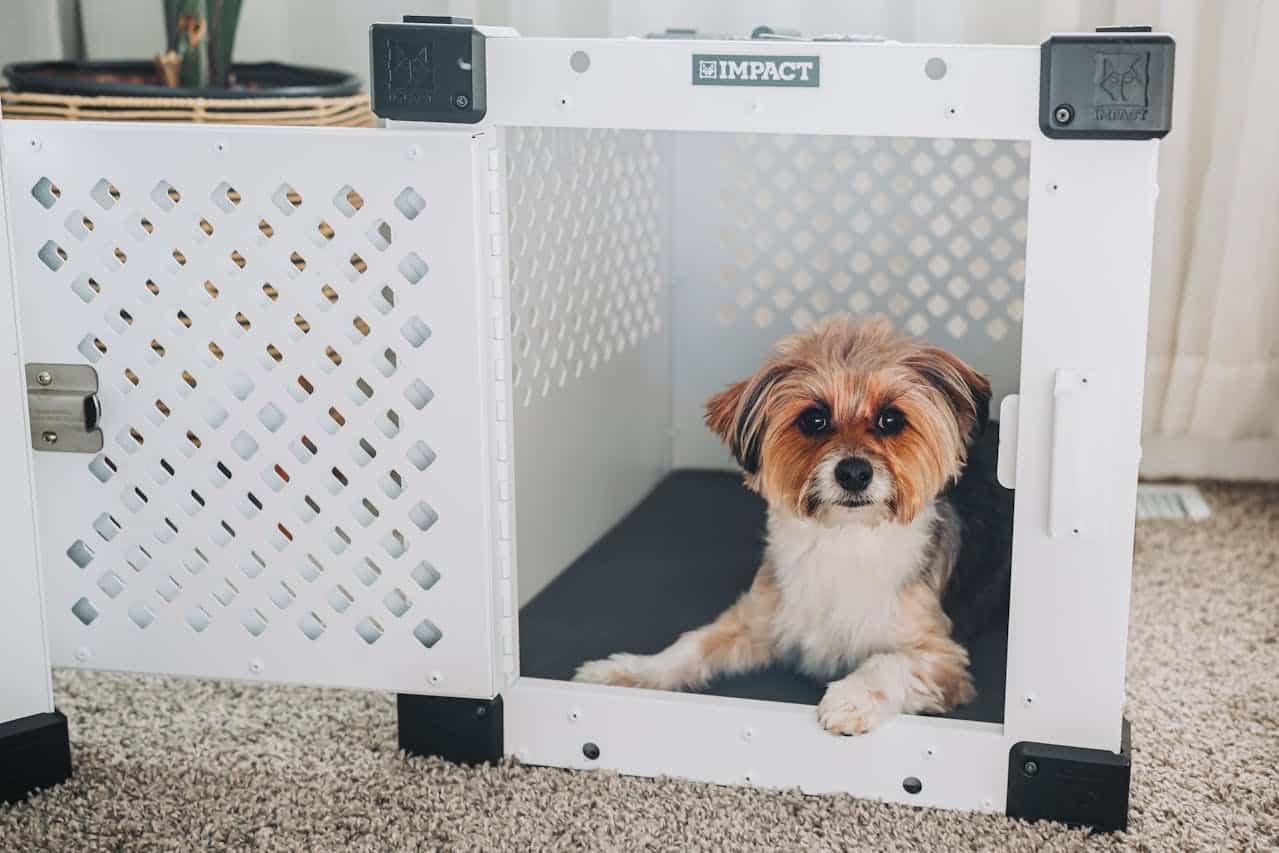
Getting the right crate is the first step in how to crate train an older dog. According to certified fear-free trainer Amanda Dwyer, your dog should be able to stand up, turn around, and lie down comfortably — not too big, not too small.
- Wire crates — good ventilation, your dog can see their environment, collapsible for storage. Best for most dogs
- Plastic crates — more enclosed and den-like. Good for anxious dogs who prefer privacy
For older dogs with arthritis or joint issues, look for a crate with easy access and a low step-in entry. Add a soft orthopedic mat — an older dog’s willingness to use the crate depends heavily on it being physically comfortable.
Step 2 — Set Up the Crate Invitingly
Place the crate in a room where your family spends time — the living room or kitchen is ideal. Dogs that feel isolated in their crate become more anxious. The crate should feel like a comfortable corner of the family space, not a banishment.
- Add a soft blanket or orthopedic mat
- Put a worn item of your clothing inside — your scent is calming
- Leave the door open initially so your dog can investigate freely
- Place a few treats just inside the entrance to begin positive associations
Step 3 — Introduce with Zero Pressure
Begin by simply letting your dog explore the crate at their own pace with the door open. Toss treats inside — first near the entrance, then progressively toward the back. Do not rush. Some dogs walk straight in on day one. Others need several days of gradual exploration.
According to Hill’s Pet training guidance, feeding your dog their regular meals near, then in the entrance of, then inside the crate builds a powerful positive association quickly. Food is one of the strongest motivators available when learning how to crate train an older dog.
For rescue dogs, a frozen stuffed KONG placed inside the crate is your most powerful tool. According to Rover training experts, 15 to 20 minutes of focused KONG-licking inside the crate does more for crate acceptance than almost anything else.
Step 4 — Add a Crate Command
Once your dog enters the crate comfortably, add a verbal cue. Say ‘crate’, ‘kennel up’, or ‘bed’ just before tossing a treat inside. After several repetitions, say the cue and point to the entrance. When your dog enters, praise warmly and reward.
Step 5 — Close the Door Briefly
When your dog is settling inside comfortably, begin to close the door for just a few seconds. Stay in the room. Open it before any whining begins if possible. Gradually extend the duration:
- 1 — Door closed 10 seconds — stay in room
- 2 — Door closed 30 seconds — stay in room
- 3 — Door closed 2 minutes — stay in room
- 4 — Door closed 5 minutes — briefly leave the room
- 5 — Door closed 15 minutes — leave the area
- 6 — Build up to 1 to 2 hours
Give a frozen KONG or long-lasting chew every time you close the door. This keeps them occupied and makes door-closing a positive event.
| ⚠️ If your dog whines Do not open the door while they are whining — this teaches whining gets results. Wait for a brief pause, then open. If whining is intense, you have moved too fast — go back to shorter durations. The key to how to crate train an older dog is always moving at the dog’s pace. |
Step 6 — Build Duration and Independence
Once your dog settles calmly for 15 to 20 minutes, begin leaving the room for longer periods. Purina recommends that when learning how to crate train an older dog, adult dogs should generally not be crated for more than 4 hours at a time during the day — they need bathroom breaks, movement, and mental stimulation.
How Long Does It Take?
Purina notes there is no definitive timeline for how to crate train an older dog. Some adult dogs settle into a crate within days. Rescue dogs with difficult histories may take weeks or months. The key metric is not speed but consistency. Never rush the process — patience produces far better results than pressure.
Frequently Asked Questions
| Q: Is it cruel to crate train an older dog?A: No — when introduced correctly, a crate becomes a dog’s den and safe space. Dogs are den animals by nature and often choose to use their crate voluntarily for rest. The cruelty is in using a crate as punishment or excessive confinement — neither of which is part of proper crate training. |
| Q: My dog cries in the crate all night — what should I do?A: You have moved to overnight too fast. Go back to shorter day sessions, building duration to 2 to 3 hours before attempting overnight. Ensure a final toilet break before crating and that the crate is comfortable with your scent inside. |
| Q: How long can an adult dog stay in a crate?A: No longer than 4 hours during the day, excluding overnight sleeping. Dogs need bathroom breaks, movement, and stimulation. If you need to be away longer, consider a dog walker, doggy daycare, or a puppy pen. |
| Q: Can I crate train a dog with separation anxiety?A: Yes but with extra care. For dogs with diagnosed separation anxiety, how to crate train an older dog requires even slower introduction, pheromone sprays inside the crate, your worn clothing inside, white noise nearby, and extremely short initial separations. Working with a certified behaviourist is strongly recommended. |
📌 Internal link: How to teach a dog to lie down — step-by-step guide → https://staging.dogsandcatshq.com/how-to-teach-a-dog-to-lie-down-4588
📌 Internal link: How to teach a dog to come when called → https://staging.dogsandcatshq.com/how-to-teach-a-dog-to-come-when-called-4594
📌 Internal link: How to teach a dog the leave it command → https://staging.dogsandcatshq.com/how-to-teach-a-dog-the-leave-it-command-4604
For the complete overview of dog training, see our complete dog training guide.
| ⚠️ Disclaimer This article is for informational purposes only. Every dog is different. If your dog has behavioural challenges or physical limitations, consult a certified professional dog trainer or veterinary behaviourist. |