Australian Cattle Dog Behavior Issues: 8 Real Problems (And How to Fix Each One)
I’ve been around dogs my whole life, and I’ll be honest — the first time a friend of mine brought home an Australian Cattle Dog, I underestimated the breed entirely. Within two weeks, the dog had dismantled a couch cushion, figured out how to open the pantry door, and started “herding” the family’s seven-year-old across the backyard. My friend wasn’t doing anything wrong. He just didn’t understand what he’d signed up for.
Australian Cattle Dog behavior issues aren’t really behavior issues at all — they’re a perfectly engineered working dog doing exactly what it was designed to do, in a home that wasn’t designed to handle it. That’s the distinction most articles miss, and it’s the one that changes everything about how you fix the problems.
For a full picture of what owning this breed involves day to day, see our guide on whether Australian Cattle Dogs are low maintenance.
Most guides will list the problems and leave you there. This one covers what’s actually driving each behavior and what specifically works to address it.
Understanding Australian Cattle Dog Behavior Issues
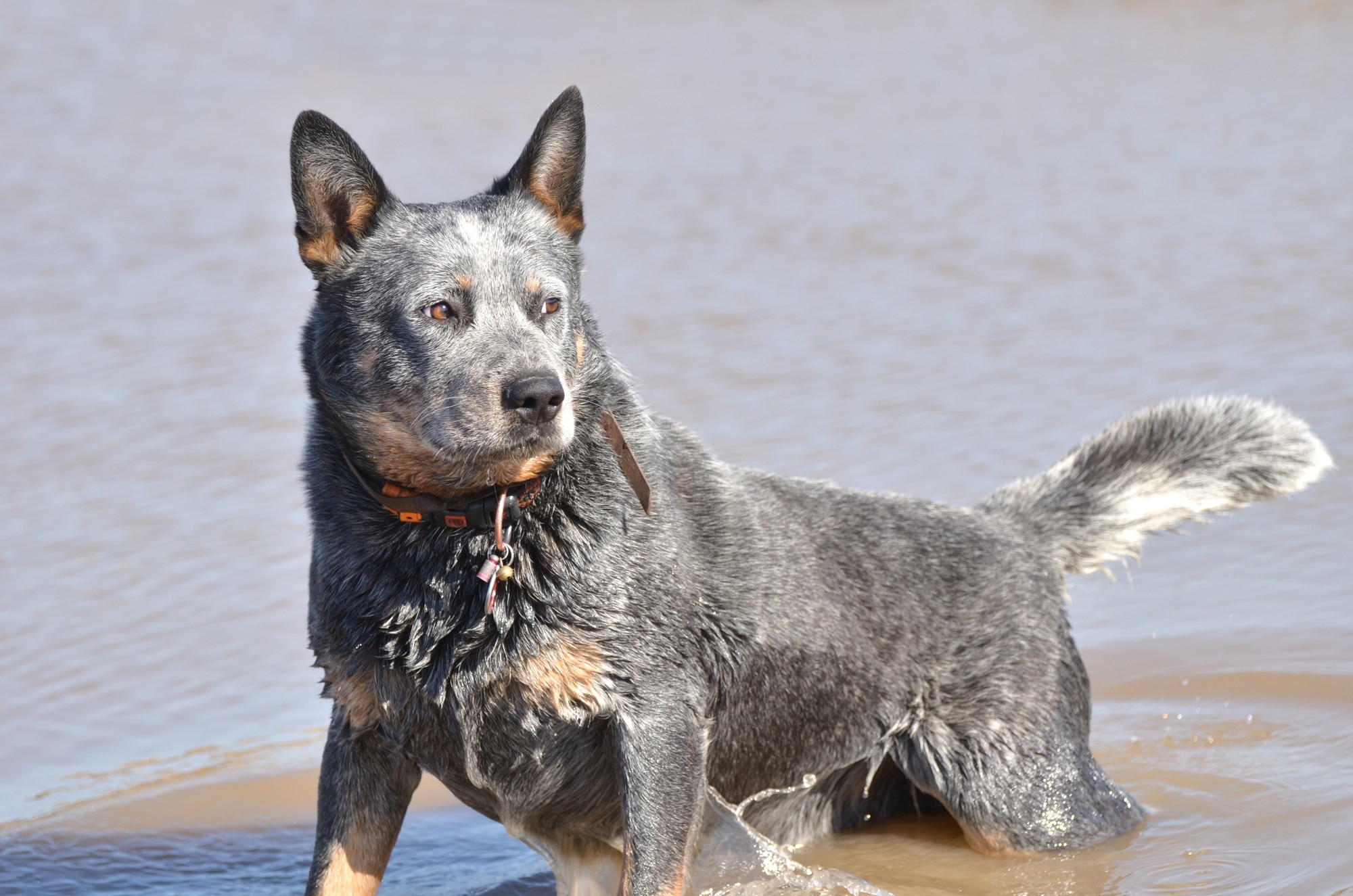
Australian Cattle Dogs — also called Blue Heelers, Red Heelers, or Queensland Heelers — were developed in 19th-century Australia to move cattle across some of the most unforgiving terrain on earth. They were bred for stamina, intelligence, independence, and a controlled willingness to use their teeth when the job required it.
That breeding didn’t disappear when the breed moved into suburban homes. Every “problem behavior” an ACD displays traces directly back to one of those traits. Keep that in mind as you read through this list — it’s the frame that makes the fixes make sense.
This post is intended to be educational. For serious aggression, fear-based behavior, or any behavior that poses a safety risk, please consult a certified professional dog trainer or veterinary behaviorist.
The most common australian cattle dog behavior issues fall into 8 categories:
1. Destructive behavior when bored
One of the most reported australian cattle dog behavior issues is destructive behavior.
What’s actually happening: An ACD that chews through furniture, digs up gardens, or barks nonstop isn’t being spiteful. It’s a working dog running on empty. These dogs were bred to cover 20–30 miles a day while making constant independent decisions. A walk around the block and a chew toy won’t cut it.
The chewing, digging, and escape attempts are what happens when a problem-solving brain has no problems to solve.
What actually helps:
- Two solid exercise sessions daily — one of which should involve running, not just walking
- Mental work every single day: scent games, puzzle feeders, obedience training sessions, or agility work
- A job, even a fake one — teaching an ACD to fetch the mail, put toys away, or learn new commands gives the brain something to do
- Rotate toys weekly; familiarity kills engagement fast with this breed
The hard truth most owners don’t want to hear: if you can’t provide 2+ hours of combined mental and physical activity daily, an Australian Cattle Dog will create its own entertainment — and you won’t like it.
2. Nipping and biting
What’s actually happening: Nipping is the ACD’s native language. Heel-nipping was literally the mechanism by which these dogs moved cattle — a quick bite to the back leg, then dodge the kick. That reflex is still wired in, and it activates around moving targets: running children, joggers, cyclists, other pets, and sometimes you.
This isn’t aggression. It’s herding. The distinction matters for how you address it.
What actually helps:
- Start addressing nipping in puppyhood — it’s much harder to undo in adult dogs
- Yelp and immediately disengage when nipped during play; walk away and ignore for 30–60 seconds
- Teach a solid “leave it” command and use it proactively when movement is triggering the behavior
- Redirect onto a tug toy or flirt pole immediately — give the prey drive something legal to chase
- Never play rough-and-tumble wrestling games with an ACD puppy; it teaches them that biting humans is part of play
One thing I’ve seen work well: structured fetch before any situation where nipping tends to happen. A dog that’s already discharged some of that chase-and-grab energy is significantly less reactive.
3. Herding children and other pets
What’s actually happening: ACDs don’t distinguish between cattle and kids. Movement triggers the herding sequence — stalk, chase, circle, nip. Children running and shrieking is, from an ACD’s perspective, a herd that needs organizing. Other pets that dart around get the same treatment.
The common mistake is punishing the herding after it happens. By then, the dog has already gotten reinforcement from the chase itself.
What actually helps:
- Teach “watch me” — eye contact with you breaks the herding focus
- Gate or tether management when children are running and the dog is amped up, especially early in training
- Teach children not to run away screaming from the dog; fleeing intensifies the drive significantly
- Practice “place” or “mat” training so you can send the dog to a designated spot when things get chaotic
- Self-control games (sit before the ball gets thrown, down before the tug toy comes out) build the habit of pausing before reacting
The goal isn’t to eliminate the herding instinct — you can’t — it’s to build a reliable “off switch” through consistent impulse control training.
4. Excessive barking
Excessive barking is also one of the australian cattle dog behavior issues that surprises new owners.
What’s actually happening: ACDs were also bred to be alert guardians of the herd. A dog that barks at anything moving near its territory — cars, neighbors, squirrels, leaves — is doing its job. The problem is the threshold is set very low, and the bark itself is often ear-splitting.
What actually helps:
- Never leave an ACD unsupervised in a yard for long periods; outdoor time without supervision becomes a barking rehearsal session
- Desensitize to trigger stimuli by exposing the dog to them at low intensity (distance, volume) while rewarding calm behavior
- Teach “quiet” as an actual trained behavior, not just a suppression command — reward the moment barking stops
- Adequate exercise dramatically lowers the baseline arousal level, which directly reduces reactive barking
- If the barking is alert-based, acknowledging it once (“okay, I hear you, enough”) and then redirecting can help — ignoring it entirely often backfires with ACDs
5. Wariness and suspicion around strangers
What’s actually happening: ACDs are naturally aloof with strangers — not aggressive, but watchful and slow to trust. This is a feature of the breed, not a flaw. The problem arises when that wariness tips into reactivity or fear-based aggression, which usually happens when socialization during the critical window (3–16 weeks) was limited.
An under-socialized ACD doesn’t just dislike strangers — it genuinely cannot read them accurately. Every unfamiliar person looks like a potential threat.
What actually helps:
- Early, broad, positive socialization is the single most important thing you can do with an ACD puppy
- For adult dogs with established wariness: counter-conditioning — pairing strangers at a safe distance with high-value treats, never forcing interaction
- Let the dog set the pace for greeting new people; forcing contact increases fear
- Ask guests to ignore the dog entirely at first, no eye contact, no reaching; let the ACD approach on its own terms
- Ongoing exposure matters — an ACD that meets new people regularly stays better calibrated than one that lives in isolation
Remember that almost all of the Australian Cattle Dog behavior issues are manageable.
6. Aggression toward other animals
What’s actually happening: ACDs have a strong prey drive and a tendency toward dog-dog dominance, particularly with dogs of the same sex. They were also bred to move and control animals — which means other pets, especially cats and smaller dogs, can trigger the chase sequence.
ACDs raised alongside cats from puppyhood generally coexist fine. Introducing a cat to an adult ACD with no prior exposure is a different situation entirely and needs careful, patient management.
What actually helps:
- Slow, controlled introductions through baby gates and barriers — let both animals get used to each other’s presence and scent before any face-to-face contact
- High-value reward training during controlled exposures to other animals
- Never assume an ACD with a high prey drive will “figure it out” off-leash; manage the environment until reliable behavior is established
- Off-leash dog parks are high-risk for many ACDs — know your individual dog before putting it in that situation
- Consistent “leave it” and recall training are non-negotiable for a dog with this level of prey drive
7. Stubbornness and pushing boundaries
Stubbornness ranks among the most misunderstood australian cattle dog behavior issues.
What’s actually happening: ACDs were bred to think independently in the field — to make decisions without waiting for a handler’s input. That independence is the same trait that makes them seem stubborn indoors. They’re not refusing commands out of spite; they’re evaluating whether compliance is worth it.
The mistake most owners make is assuming affection and treats alone will carry them. With ACDs, respect and consistency matter as much as reward.
What actually helps:
- Clear, consistent rules enforced every single time — ACDs test for inconsistency and will exploit it
- Positive reinforcement-based training works well with this breed when combined with structure; purely permissive approaches do not
- Short, varied training sessions beat long repetitive ones — boredom leads to non-compliance
- Building drive for the reward (making yourself interesting, using high-value treats for new or difficult behaviors) helps
- Work with a trainer who has specific experience with herding breeds if you’re struggling; generic advice often misses the mark with ACDs
8. Separation anxiety
What’s actually happening: ACDs bond intensely — often to one person in particular. The flip side of that loyalty is that being left alone feels genuinely distressing to many of them. Destructive behavior, vocalization, and escape attempts when alone are often anxiety-driven, not boredom-driven — though both can look the same on the surface.
What actually helps:
- Build up alone time gradually from puppyhood; don’t just leave a puppy for 8 hours and hope for the best
- Practice departure cues without actually leaving — pick up keys, put on shoes, then sit back down — to reduce the spike of anxiety around pre-departure signals
- Provide a safe, comfortable space (a crate if the dog is crate-trained and comfortable in it) rather than free range of the house
- Physical exercise before departure genuinely helps — a tired dog is calmer
- For severe cases, consult a veterinary behaviorist; medication combined with behavior modification is sometimes the most humane and effective path
The honest summary on Australian Cattle Dog behavior issues
Australian Cattle Dog behavior issues are almost always a mismatch problem — a working dog in a situation that doesn’t meet its needs. The good news is that the same intelligence that creates the problems also makes ACDs genuinely trainable when you work with their nature instead of against it.
They’re not for everyone. But if you can meet their needs, they’re one of the most rewarding breeds you’ll ever own. The Australian Cattle Dog behavior issues are manageable.
For more on this breed, see our full Australian Cattle Dog breed guide — it covers everything from exercise requirements to health considerations.
Michael Burrows has been around dogs his entire life and has owned dogs for over 15 years. He writes about dog behavior, training, and breed characteristics based on personal experience and research. This content is for educational purposes only and does not constitute professional veterinary or training advice.